The Snowbird Open the House Checklist for Palm Beach County
Roughly 145,000 seasonal residents come into Palm Beach County every year. Here is the two-visit rhythm that keeps a seasonal house from eating your first week: what to open in October through December, and what to shut down in April and May.
Key takeaways
- Palm Beach County adds an estimated 158,876 seasonal residents, about 10.3 percent on top of the year-round population.
- Arrivals cluster in two waves: roughly 27 percent land October through December and 28 percent January through March.
- Open the house in October through December: batteries, filters, locks, touch-up paint, screens, patio.
- Close it in April and May, ahead of the June 1 start of hurricane season.
- We deploy and remove storm panels you already own. Putting in a new panel system is a licensed trade we refer out.
Two visits, six months apart
Palm Beach County has a second population that arrives on a schedule. The county estimates an additional 158,876 seasonal residents, about 10.3 percent on top of the 1,545,905 year-round figure. A local real estate source puts it at roughly 145,000 snowbirds raising the county population by about 11 percent, which lines up. Arrivals cluster in two waves: roughly 27 percent land October through December, and about 28 percent January through March, with the season in full swing from January to March.
Highland Beach is the extreme version of this. Its seasonal population runs at around 55 percent of its permanent population. Boca Raton adds over eleven thousand seasonal residents, Jupiter over ten thousand, West Palm Beach, Delray Beach and Boynton Beach around eight thousand each. If your building feels empty in July and full in February, that is why.
The practical shape of a seasonal house is two visits, not twelve. One when you open in October through December, one when you close in April and May. Everything below is organized around those two appointments, and it exists because the alternative is spending your first week down here on a ladder instead of on the beach.
Book the open-house visit before you fly. October and November are the busiest weeks of the year for anyone doing this work in this county, and the person who calls in September gets the morning slot.
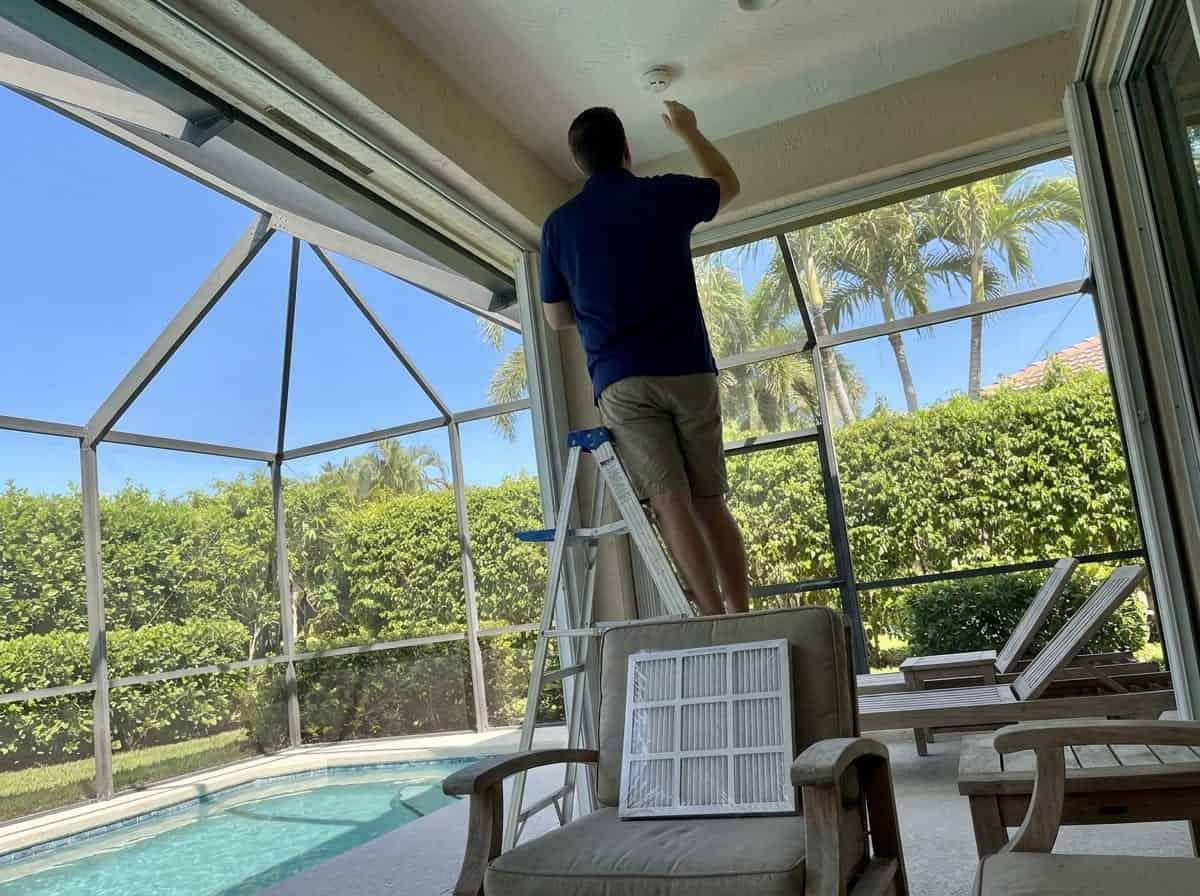
Batteries: the first hour of the visit
Batteries are the single most common reason a returning owner spends their first night awake. Smoke alarms chirp at three in the morning at a frequency engineered to be impossible to sleep through and difficult to locate. A house that sat closed for six months in Florida heat will have several ready to go.
Everything on the battery list: smoke and combination alarms in every bedroom, hallway and living area, plus one on each level. Thermostat batteries, which fail quietly and take the cooling system with them. Keypad and smart lock batteries, which is the one people forget and then get locked out over. Garage door remotes and the keypad on the outside jamb. Door and window sensors if you have a monitored system. Ceiling fan and TV remotes. The doorbell if it is battery-powered.
Write the date on the alarm with a marker when the battery goes in. It sounds fussy. It saves an argument with yourself next October about whether these are the new ones or the old ones.
One note specific to condo buildings: many Palm Beach County associations have their own alarm testing schedule for units, and some require access during a set window. Worth checking with your manager so you are not doing the same job twice.
Filters, air, and the smell of a closed house
A closed Florida house in August is a humidity experiment. Air filters that sat in a system running at a holding temperature all summer come out gray and stiff. Change every filter in the unit, including the return in the hallway ceiling that most people forget exists, and the refrigerator water filter if the unit has one.
Run the system and stand in each room. What you are listening and smelling for is not a repair, it is information: musty air in one bedroom and not the others, a return that is barely pulling, condensation on a vent register. Those get flagged to you in writing so you can decide whether to bring in the company that services your equipment. We are not that company and we will not pretend to be.
Open the sliders and let the house breathe for an hour while other work happens. Wipe the tracks. Six months of closed sliders in salt air leaves grit that will chew the rollers if you force the door.
Look up at ceilings and along the tops of exterior walls, especially the north-facing rooms and any wall behind a piece of furniture pushed tight. Mildew spotting shows up there first in this climate. Small spotting is a cleaning and touch-up paint job. A stain with a shape and a hard edge is something to photograph and investigate before painting over it, and we will tell you which one you have.
Locks: rekey after the cleaners
Make a list of everyone who held a key to your house while you were gone. Cleaning service. Pool service. Home watch. The neighbor who took in packages. Your daughter, who stayed for a week in March and may still have a copy in a drawer in Connecticut. For most seasonal households that list is longer than they expect.
Rekeying resets it without a single awkward conversation. The hardware stays on the door, the pins change, the old keys stop working. Doing it as part of the open-house visit means the season starts with a known list of key holders instead of an inherited one.
While the technician is on the doors: check every deadbolt throws fully into the strike without lifting the door, check the patio slider lock and the auxiliary pin, check the door from the garage into the house, and check the mailbox. Salt air corrodes lock mechanisms faster than anything else on the exterior of a house, and a lock that needs to be jiggled today is a lock that will fail in February.
Households with regular help often move to a battery keypad on the main door, so a code can be issued to a cleaner and deleted at the end of the season. Battery keypad locks are a clean handyman job. Hardwired access hardware is not, and it is not something we take on.
Touch-up paint and the small-repair punch list
Six months of nobody watching produces a specific list. Scuffs along the hallway where furniture was moved. A patch of wall behind a door that never got a stopper. Bathroom caulk that has gone from white to something else. Interior door edges swollen slightly from humidity and now catching on the jamb.
Bring the paint cans out of the closet before we arrive if you have them. Match is far easier with the original can, and most Palm Beach County association-governed exteriors have a published palette that makes the outside straightforward, but interiors are whatever the last owner chose and can only be matched to a sample.
Doors that stick are usually a hinge and strike adjustment, not a planing job. In this climate a door that binds in October may swing freely in February, so the fix is done with the season in mind rather than shaved to fit one humid week.
Group the small stuff into the same visit. Curtain rod that pulled out of the wall, TV that came off the mount for storage and needs remounting, shelf that sagged, blinds with a broken tilt wand, a mirror that needs to go back up. These are minutes each when they are batched and a whole separate trip when they are not.
Screens, patios and the outside walk
Screened patios take the worst of a Florida summer. Walk the whole enclosure and look for tears at the corner splines, a panel bulging from wind load, and the door that no longer latches because the frame has shifted a few millimetres. Removable screen panels get repaired or re-screened; anything involving the enclosure frame itself is outside what we do.
Window screens come next. In older housing stock they are frequently missing entirely, having blown out during a storm and been quietly thrown away. Count them against the number of windows before you assume they are all there.
Pressure washing is the cheapest visual improvement a seasonal house gets. Driveway, walkway, patio slab, pool area surround, and the north and east elevations where algae takes hold. In HOA communities this is also the thing that keeps a violation letter from arriving in your mailbox in January while you are trying to enjoy the season.
Then look up. Gutters full of six months of leaves will overflow at the wall during the first serious afternoon storm. Cleaning them out on the open-house visit is far easier than doing it in June with a storm named.
Closing up in April and May
The close-up visit has a different job. You are not making the house comfortable, you are making it defensible for six months, and it needs to be finished before hurricane season opens on June 1.
The list: set the cooling system to a holding temperature that manages humidity, fresh filters going in rather than coming out, batteries again on anything that will need to run unattended, patio and balcony cleared of furniture, planters, umbrellas and anything else that becomes a projectile, pool area cleared, exterior touch-up done before the summer rain, and a full set of documentation photos of every room and the contents for your records.
Storm panels: if you already own panels or accordions, we put them up and take them down, and we clean and lubricate the tracks while we are there. That is the part of storm protection that is genuinely a handyman service. Putting in a new panel system is a licensed trade we refer out, it requires a permit, and it belongs with the company that supplies the system.
Rekey again on the way out if a new set of people is going to hold keys over the summer, and leave one known key holder and one emergency contact with your management office. Then get on the plane.
Common questions
When should I book the open-house visit for a Palm Beach County home?
Call in September for an October or November appointment. Roughly 27 percent of seasonal arrivals land October through December, and every one of them wants the same two weeks. The open-house visit runs best a few days before you land, so the batteries, filters, locks and touch-ups are done and the house is comfortable when you walk in rather than a week later.
Do you deploy hurricane panels for seasonal owners in Palm Beach County?
Yes, if the panels or accordions are already on the property. We put them up, take them down, and clean and lubricate the tracks while we are there. Putting in a new panel system is a different matter: it requires a permit and it is a licensed trade we refer out, so that work belongs with the company that supplied the system.
Is it worth rekeying every season?
For most seasonal households, yes on the way in and often on the way out. Cleaners, pool service, home watch and visiting family all accumulate keys over a six-month absence, and nobody keeps a reliable list. Rekeying keeps your existing hardware and just changes which key works, so it is fast and it resets the whole access list without a conversation.
What do you flag rather than fix on an open-house visit?
Anything that belongs to another trade. Water-line, wiring, and storm-shutter work are licensed trades we refer out, and so is anything involving the frame of a patio enclosure. A ceiling stain with a hard edge, a cooling system that is not pulling properly, or a wall that feels damp gets photographed and written up for you with a clear recommendation, not painted over.
Sources
Every figure quoted above comes from one of these. Ranges are what other providers and cost trackers report, not our prices.
- Palm Beach County profile, population and seasonal population
- Meyer Lucas, snowbird season in Palm Beach County
- Waterfront Properties, when is peak season in South Florida
- WPTV, snowbird season underway in South Florida
- NOAA National Hurricane Center, Atlantic hurricane season dates
- Palm Beach County regulated trades and standards for certified categories
Interior Painting in Palm Beach County
Interior repaints for homes and condos county wide. Clean lines, covered floors, and coatings picked for humid rooms.
See how it worksWhat we do in Delray Beach
The housing stock, the association rules, and the questions people in Delray Beach actually ask.
Delray Beach service pageWant it quoted instead of researched?
Send the list and a couple of photos and we will come back with a price.