Hurricane Season Prep for Palm Beach County Condo Owners
In a condominium, hurricane prep is a shared job with a hard line down the middle. Here is what Florida law puts on the association, what stays with you as the unit owner, and the parts a handyman can genuinely take off your list.
Key takeaways
- Atlantic hurricane season runs June 1 to November 30, and a large share of Palm Beach County condo owners are out of state for most of it.
- Florida law puts maintenance of the common elements on the association, except limited common elements assigned to the owner by the declaration.
- Florida law requires the board to adopt hurricane protection specifications, including color and style, and an owner cannot be refused approval for protection that conforms to them.
- A handyman can deploy panels you already own, secure furniture and planters, replace batteries, clean gutters, seal gaps, and document the unit in photographs.
- Putting in a new storm protection system needs a permit and a county certificate. That is a licensed trade we refer out.
The dates, and why they land badly for condo owners
The Atlantic hurricane season runs from June 1 to November 30. That is a six-month window, and for a large share of Palm Beach County condominium owners it is precisely the six months they are not here.
The county counts an estimated 158,876 additional seasonal residents, roughly 10.3 percent on top of the year-round population, and arrivals cluster from October through March. In condominium-heavy places the effect is extreme: Highland Beach carries a seasonal population equal to about 55 percent of its permanent one. Buildings in Boca Raton, Delray Beach, Boynton Beach and along the barrier island run half empty through the exact months when storms form.
So the practical hurricane plan for a seasonal condominium owner is not a plan for what you do when a storm is named. It is a plan for what is already true about your unit before you fly north in April or May, and who can act on your behalf while you are gone.
This county has 2,537 condominium and cooperative associations covering 188,991 units, and a great deal of that stock dates from the 1970s and 1980s. Older buildings, catwalk access, open balconies, and a lot of absent owners is a combination that rewards preparation and punishes improvisation.
Who is responsible for what
Start with the statute, then read your own declaration, because the declaration is what actually decides the edge cases.
Florida Statutes section 718.113 covers maintenance, limitations on improvement, and hurricane protection. Subsection (1) states the general rule: maintenance of the common elements is the responsibility of the association, except for any maintenance responsibility for limited common elements assigned to the unit owner by the declaration. That last clause is where most disputes live. Balconies, catwalk-facing entries, screens and windows are frequently limited common elements, and whether they are yours or the association's depends on the document, not on intuition.
Subsection (5) is the hurricane protection provision and it is worth knowing. Each board must adopt hurricane protection specifications for the buildings within the condominium, and those specifications include factors such as color and style and must comply with the applicable building code. Installation and maintenance of hurricane protection under those specifications is not treated as a material alteration or substantial addition to the common elements. The board may install protection or, with the required owner approval, require owners to do so. And a unit owner may not be refused approval for hurricane protection that conforms to the board's adopted specifications.
What that means for you in September: ask the management office for the adopted hurricane protection specifications and for the section of the declaration that defines limited common elements. Those two documents tell you which items on the list below are yours to handle and which you should be reporting rather than fixing.
None of this is legal advice, and association documents vary enormously across this county. When a real dispute arises about who owns a repair, that is a question for a Florida attorney who handles association work.
The unit owner list, balcony first
Everything loose on a balcony, catwalk or patio becomes a projectile. Furniture, cushions, side tables, umbrellas, planters, mats, wind chimes, hose reels, grills where the association permits them, and the small decorative items people forget because they have been there for years.
The right answer for most units is to bring it inside, not to tie it down. Many Palm Beach County associations require balconies to be cleared entirely when a storm watch is issued, and some specify that in the rules regardless of what the owner thinks is secure. If items physically cannot come inside, they go where the association directs.
Inside the unit, the work is documentation and readiness. Photograph every room, wall to wall, including the contents of closets, and photograph the balcony and the entry. Date-stamped photographs taken before a season are worth more to an insurance claim than any description written afterward. Store them somewhere that is not in the unit.
Then the small mechanical items. Fresh batteries in smoke and combination alarms, in the thermostat, and in any keypad or smart lock, so a caretaker or family member is not locked out mid-season. Fresh air filters. A cooling system left at a holding temperature so the unit does not sit at Florida humidity for five months. Know where your water shut-off valve is and make sure it is accessible rather than behind a stack of boxes.
Finally, contacts. The management office should have a current phone and email for you, one local key holder, and written authorization for whoever you want them to admit to your unit. Every year buildings in this county end up unable to reach an owner about their own unit.
What a handyman can genuinely do here
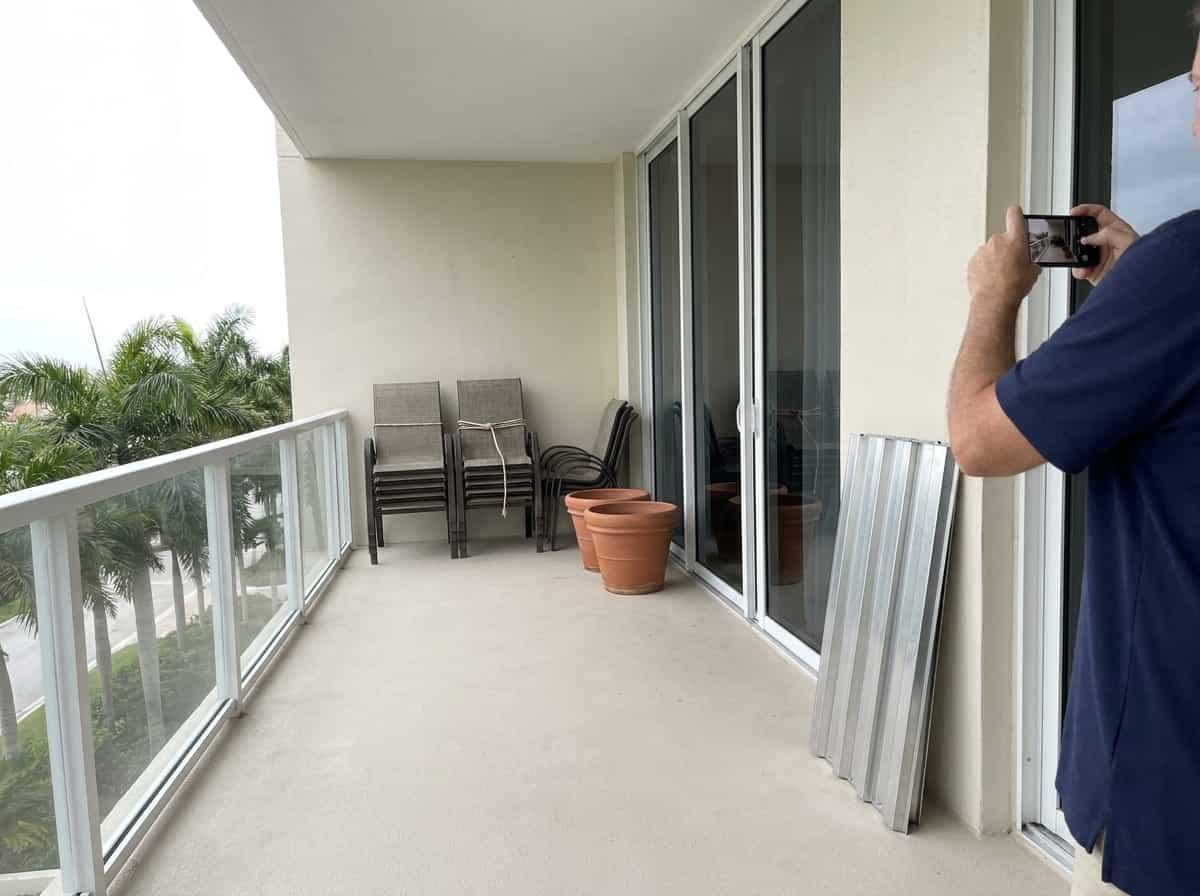
Panels you already own: we put them up and we take them down. If your unit has storm panels, accordions or a track system already fitted, deploying and removing them is straightforward service work, and so is cleaning and lubricating the tracks so the system actually closes when it is needed. This is the single most valuable item on the list for an absent owner, because panels sitting in a storage cage do nothing.
Securing the balcony: furniture moved inside, planters relocated, umbrellas taken down and stored, loose items cleared. It is unglamorous and it is exactly what a building manager wants done before a watch is issued.
Batteries, filters and bulbs across the unit, in one visit, on a known date, with a written list of what was replaced.
Pre-storm photo documentation of every room and the balcony, delivered to you as a dated set. Post-storm, the same walk again so you have a genuine before and after.
Gutter cleaning and general water management on units that have them, caulking and weatherstripping around doors and window frames to cut down wind-driven water intrusion, exterior touch-up painting before the summer rain sets in, and a check on every lock and door closer so nothing on the unit is left unsecured.
And rekeying, which sounds unrelated until you count how many people held a key to your unit over the season. Rekeying before you leave resets the access list to whoever you actually want in there while you are gone.
What is not a handyman job
Putting in a new storm protection system is the clearest line. Palm Beach County requires a Certificate of Competency to advertise, bid, or contract work in a set of trades and specialty categories, and storm shutter and awning work is one of them. Permits are also required for essentially all permanent storm protection in South Florida, issued by the city if you are inside city limits and by the county if you are not.
So the split is simple and we will say it plainly: we deploy and remove protection that is already on your unit. New systems belong with the company that supplies and fits them, and that is a licensed trade we refer out. Water-line and wiring work sit on the same side of that line.
There is one more restriction worth stating, because it protects you as much as it protects us. Florida law treats work performed without the required credentials during a declared state of emergency far more seriously than at other times. In the days after a storm, this county fills up with people offering repair work out of a truck. Ask for credentials, refuse to pay large sums up front, and be suspicious of anyone who found you rather than the other way around.
Post-storm, what we do is cleanup, panel removal, documentation photos, board-up removal, and putting your balcony back together. What we do not do is repair work that belongs to a certificated trade, no matter how urgent it feels.
A calendar you can actually follow
March or April: request the adopted hurricane protection specifications and the limited common element section of your declaration from the management office. Confirm your contact details and key holder authorization are current.
April or May: the close-up visit. Panels checked and tracks serviced, balcony cleared, batteries and filters replaced, caulking and weatherstripping refreshed, gutters cleared, exterior touch-up done, unit photographed room by room, locks checked and rekeyed if the season's key list needs resetting. Finish before June 1.
June through November: watch the season from wherever you are, and have an arrangement in place for panel deployment on short notice. A named storm is not the moment to start looking for someone who can get into your building.
October through December: the open-up visit as you come back. Panels down and stored, tracks cleaned, balcony reset, filters and batteries again, screens checked, touch-up paint for whatever the summer did to the walls.
The whole point of the two-visit rhythm is that it turns a six-month worry into two appointments. We work with owners and with management offices across the county, we carry a certificate of insurance for the building file, and our technicians are background checked so a manager can admit us to your unit without a problem. Call (645) 235-4470.
Common questions
Is my condo association responsible for hurricane protection on my unit?
Partly, and your declaration decides the rest. Florida law puts maintenance of the common elements on the association, except for limited common elements assigned to the unit owner by the declaration, and balconies and apertures are often limited common elements. The law also requires the board to adopt hurricane protection specifications including color and style, and an owner cannot be refused approval for protection that conforms to them.
Will you put my hurricane panels up if I am out of state?
Yes, if the panels or accordions are already at the unit. We deploy them, remove them afterward, and clean and lubricate the tracks so the system closes properly when it is needed. Arrange it before you leave for the summer, together with access authorization at the management office, so nothing has to be sorted out while a storm is being tracked.
What should a Palm Beach County condo owner do before June 1?
Clear the balcony completely, bring in furniture and planters, replace batteries in alarms, thermostat and keypad locks, change filters, set the cooling system to a humidity-holding temperature, photograph every room and the balcony with dates, refresh caulking and weatherstripping, clean gutters where you have them, and confirm the management office has your current contacts and an authorized key holder.
Can you repair storm damage to my unit after a hurricane?
Only within our own scope. We do cleanup, panel removal, documentation photos and putting your balcony back together. Repair work belonging to a certificated trade is not ours, and Florida treats work done without the required credentials during a declared state of emergency very seriously. Water-line, wiring, and storm-shutter work are licensed trades we refer out, and we will point you to the right company.
Sources
Every figure quoted above comes from one of these. Ranges are what other providers and cost trackers report, not our prices.
- NOAA National Hurricane Center, Atlantic hurricane season dates
- Florida Statutes 718.113, maintenance, limitation upon improvement, hurricane protection
- Palm Beach County profile, population and seasonal population
- HOA Census, Palm Beach County association and unit counts
- Palm Beach County regulated trades and standards for certified categories
- Storm Smart, permits for hurricane protection in Florida
- Florida Statutes 489.127, penalties including during a declared state of emergency
Gutter Cleaning in Palm Beach County
Gutters and downspouts cleared by hand, flushed, and photographed, on homes up to two stories.
See how it worksWhat we do in Highland Beach
The housing stock, the association rules, and the questions people in Highland Beach actually ask.
Highland Beach service pageWant it quoted instead of researched?
Send the list and a couple of photos and we will come back with a price.