Snowbird Open and Close
Two seasonal visits a year for absent owners. Open the house in October to December, close it in April or May.
Clearing palm debris, sand, and blown leaves before the wet season loads them up.
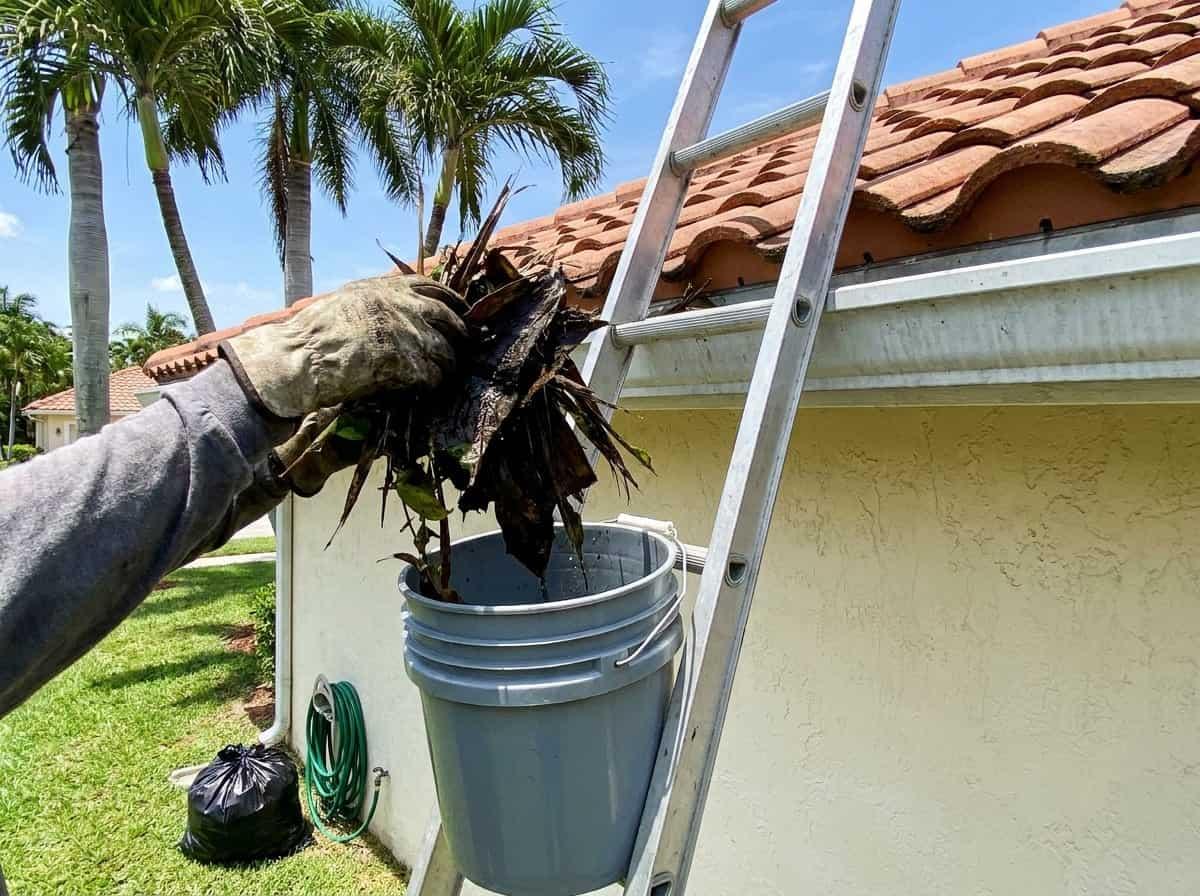
We check the full length before starting, note where debris is heaviest, and look for separated joints, loose hangers, and standing water that suggests a low spot. That tells you whether cleaning alone solves the problem.
Debris comes out by hand into bags rather than being blown onto your walls and landscaping. Then we flush the run and the downspouts with water and watch where it goes, because a gutter that looks clean can still have a blockage further along.
You get photos of the before and after, plus anything we noticed that is worth handling later. Debris leaves with us and anything splashed on the wall below gets rinsed.
It is not autumn leaves. In Palm Beach County the load is palm debris, fronds, seed pods, and the constant fine litter that palms shed all year, mixed with sand, roof grit, and whatever the wind has brought in from a neighboring property. Live oaks and ficus add a steady fine leaf drop that packs down into a dense mat.
That mixture behaves differently from leaf fall. It compacts, it holds water, and it turns into a heavy, wet layer that a blower cannot shift and that puts real weight on the hangers. It also stays wet long enough to grow things, which is why owners sometimes find plants sprouting in a gutter run here.
Storm season runs June 1 to November 30, and a South Florida downpour delivers more water in twenty minutes than many climates see in a week. A blocked gutter in that rain does not trickle over gently. It sheets water over the edge in volume, straight down against the wall, the window heads, and the foundation line, and it does that repeatedly through the wet months.
That is the mechanism behind a lot of the water problems owners blame on other causes: staining down a stucco wall, water appearing at a window head, saturated soil right against the house. Clearing the runs in the spring, before the season opens, is one of the cheapest preventive jobs available on a house here.
The county gains a large seasonal population each winter and loses it each summer, which means a great many homes here sit unwatched through exactly the months when gutters fill and storms arrive. Nobody is there to notice water sheeting off a corner, and the damage accumulates quietly until October.
This is why we treat gutter clearing as part of the April or May close up visit rather than something to do on arrival. It goes alongside sealing exterior joints, securing the patio, and pulling window units, and the photos we send give an absent owner an actual record of the property's condition going into the season.
We clean gutters on single and two story homes from ladders, and we do not go above two stories. We also do not do roof work of any kind. If we see something on the roof worth attention, we photograph it and tell you, and you take that to the appropriate trade.
New gutter systems and section replacement go to the licensed trades we refer out. Where a joint has separated, a hanger has pulled, or a run has developed a low spot holding standing water, we will show you the photo and be straight about whether cleaning is going to help. Cleaning a gutter that is failing at the joints is money that buys you nothing.
In many association communities in this county, gutters on a townhome or a villa are common element, maintained by the association, and an owner arranging their own cleaning is paying for something they already fund through assessments. In others, they are explicitly the owner's responsibility.
It is worth checking your documents before booking. We are happy to tell you what we typically see in your type of community, but the governing documents decide it, not us. Where the association handles it, the useful thing an owner can do is report a run that is clearly overflowing rather than waiting for the annual schedule. If your home has gutter guards already fitted, tell us at booking. Some types have to come off to clear the run properly and go back after, and that changes how long the visit takes on a two story home with long runs under mature palms.
Packages that usually include this work.
Two seasonal visits a year for absent owners. Open the house in October to December, close it in April or May.
A standing program for associations and management firms: unit turns, punch lists, painting, and lock work on one monthly invoice.
Punch list work between guests: locks reset, walls touched up, blinds and furniture repaired, photo report on completion.
We cover 39 cities, villages, and towns in Palm Beach County. These are the seven largest.
See all 39 service areasMost homes here want it at least once a year, timed for spring before storm season opens on June 1. Properties with palms, live oaks, or ficus close to the house usually need twice, because palm litter and fine leaf drop compact into a dense wet mat rather than blowing out the way autumn leaves do.
Late spring, before June 1. That is when the runs are carrying the dry season's accumulated palm debris and sand, and it is right before the months that deliver the heaviest rain. For seasonal owners it belongs in the April or May close up visit, so the house goes into the summer clear.
No. We work from ladders on single and two story homes and we do no roof work at all. If we see something up there worth attention we photograph it and tell you so you can take it to the right trade. We also do not access anything above two stories.
That usually means a separated joint, a pulled hanger, or a low spot where the run holds standing water, none of which cleaning fixes. We photograph what we find and tell you plainly. New systems and section replacement go to the licensed trades we refer out rather than us patching around it.
It depends on your governing documents. In many Palm Beach County townhome and villa communities, gutters are a common element the association maintains, and an owner paying separately is paying twice. In others they are clearly the owner's. Check your documents before booking, and report an obviously overflowing run either way.
We clear by hand into bags and take it away. Blowing a wet, compacted mix of palm litter and sand out of a gutter puts it on your walls, your windows, and your landscaping, and much of it does not move anyway. After clearing we flush the run and the downspouts and rinse anything that got splashed.
Tell us what you need done and roughly where in Palm Beach County you are. Photos help. We come back with a price, not a sales visit.