You Got an HOA Paint Violation Letter in Florida. Here Is What to Do.
A faded wall, a chalky garage door, a front door two shades off the approved color. Palm Beach County associations issue paint violations constantly. Here is what the letter means under Florida law, how the fine process actually works, and how to close it out.
Key takeaways
- Florida law gives you at least 14 days written notice of your right to a hearing before an association can impose a fine.
- Fines are capped at $100 per violation and $1,000 in the aggregate for both homeowners associations and condominium associations, subject to the governing documents.
- The hearing is before a committee of at least three people who are not officers, directors or employees of the association.
- Architectural authority has to be stated or reasonably inferred in the declaration or published guidelines, and where the guidelines offer options you may choose among them.
- Get written approval, photograph before, during and after, and email the set to your manager to close the file.
What the letter actually is
Palm Beach County is unusually dense with associations. County data shows 2,537 condominium and cooperative associations covering 188,991 units, which is roughly 27 percent of the county housing stock before you count single-family communities with a homeowners association on top. If you own here, the odds are good that somebody is empowered to write to you about your paint.
A violation letter is a notice of an alleged breach of the governing documents, usually the declaration or the published architectural guidelines. It is not a fine and it is not a lien. It is the opening move, and in the overwhelming majority of cases it is closed out quietly by doing the work and sending photographs.
Read it slowly and pull out four things: the specific provision cited, the exact condition complained of, the deadline, and the name and contact of the person handling it, which is normally the community association manager rather than a board member. Everything after this is easier if you talk to the manager early rather than after the deadline.
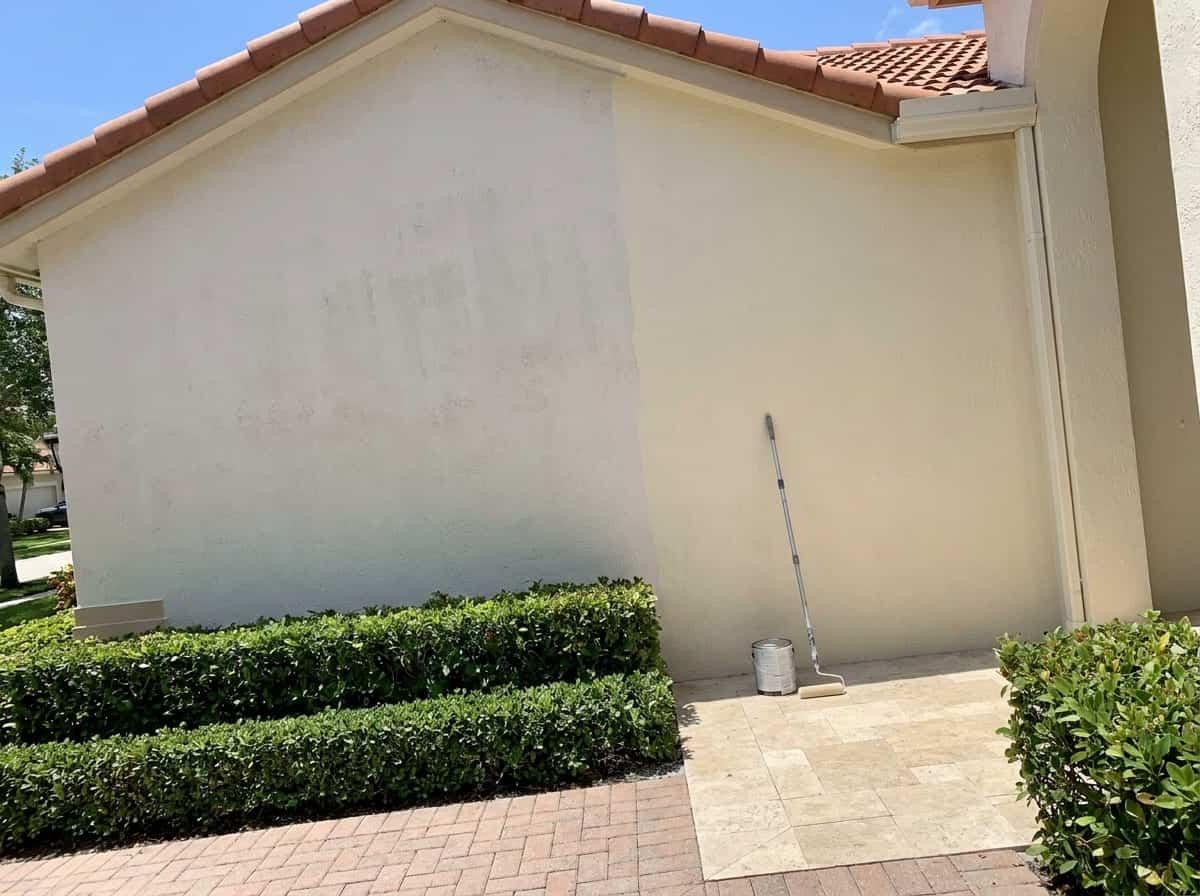
The most common paint violations we see in this county are predictable: chalking or faded stucco on south and west elevations that take the full afternoon sun, a front door that has been repainted a shade nobody approved, a garage door that has oxidized to a different tone than the wall around it, mailbox posts, and trim that has gone from white to a soft yellow. None of these are dramatic and all of them have the same answer.
How the fine process works under Florida law
Two statutes govern this depending on what kind of association you are in. For homeowners associations, Florida Statutes section 720.305 covers obligations of members and the levy of fines and suspension of use rights. For condominium associations, section 718.303 covers obligations of owners and occupants and the same remedies.
Both work the same way on the two points that matter to you. First, a fine may not exceed $100 per violation, with an aggregate cap of $1,000, unless the governing documents provide otherwise. Second, and more useful: the board must give you at least 14 days written notice of your right to a hearing before it can impose the fine.
The hearing itself is not in front of the board. Under both statutes it goes to a committee of at least three members appointed by the board who are not officers, directors or employees of the association, and under the condominium statute not close relatives of them either. That committee votes on whether to confirm or reject the proposed fine. If the committee rejects it, the fine cannot be imposed. Under section 720.305 the hearing must be held within 90 days after the notice is issued, and it may be conducted by telephone or other electronic means.
One difference worth knowing if you are in a condominium: under section 718.303 a fine cannot become a lien against your unit. That does not make ignoring it a good idea, because associations have other remedies and because a documented history of unresolved violations follows a unit at resale.
None of this is legal advice. If the amount is significant, the alleged violation is disputed, or the association is escalating, talk to a Florida attorney who does association work. There are a great many of them in this county for exactly this reason.
Find the approved palette before you buy any paint
This is where most people lose their deposit of goodwill: they fix the problem with the wrong color and receive a second letter for an unapproved change. Do not buy paint until you have the palette in your hand.
Florida Statutes section 720.3035, on architectural control covenants and parcel owner improvements, sets the frame for homeowners associations. Architectural review authority is permitted only to the extent that it is specifically stated or reasonably inferred in the declaration of covenants or in published guidelines, and the association must apply and enforce those standards reasonably and equitably across all parcel owners. The statute also protects a useful right: where the guidelines offer more than one option for materials or design, the owner may select from the options provided.
In practice that means three requests to your manager. Send the current approved palette with manufacturer names and color codes. Send the architectural application form. Send the written approval once it is granted. Most Palm Beach County communities have all three as PDFs and will email them the same day.
Read the palette carefully for scope. Many communities specify a body color, a trim color, and a small set of permitted accent colors for front doors and shutters, and some specify sheen as well as color. A flat where a satin was specified is a real violation even when the color is exactly right.
If your community has repainted common buildings recently, ask whether the palette changed. Boards update palettes and the copy circulating in an old owner packet may be two revisions behind.
A realistic timeline in Palm Beach County
Owners routinely underestimate this and then miss a deadline they could have extended by asking. Build the schedule backwards from the date on the letter.
Approval takes as long as it takes. Some managers can issue approval for a repaint in the existing approved colors within days. An architectural committee that meets monthly is a different situation, and if your community works that way, you want your application in before the next meeting rather than after it.
The work itself has a weather problem. Exterior painting in Palm Beach County has to fit around afternoon storms from roughly June through October, and around dew point in the early morning year round. Stucco that has been pressure washed needs to dry properly before coating, and in a humid week that is longer than a homeowner expects. A typical single-family exterior repaint runs several working days end to end including wash, dry, prep, caulking and two coats. A front door, a garage door or a mailbox post is a single visit.
If the deadline is not achievable, ask for an extension in writing before it expires and attach evidence that the work is booked. Managers approve reasonable extensions routinely when they can show the board that the owner is acting. They are far less receptive to a request that arrives after the fine notice has already gone out.
Photographs the board will actually accept
The point of the photo set is to let a manager close your file without a site visit. Make that easy and your violation goes away quietly.
Take a wide shot of the whole elevation before work starts, from the same position you will use later, plus a close shot of the specific condition named in the letter. Photograph the paint can labels showing manufacturer, color name and code, so the record proves the approved palette was used. Take one shot mid-job showing preparation, because a board that sees a washed and prepped wall stops worrying about whether the work was done properly.
Then take the after shots from the same two positions as the before shots. Matching angles is what makes a photo set persuasive. Shoot at the same time of day if you can, because Palm Beach County midday sun makes a wall look several shades lighter than the same wall at four in the afternoon, and a board comparing a bright before with a shadowed after will see a mismatch that is not there.
Email the set to the manager as a single message that references the violation number and the date of the letter, states what was done, and asks for written confirmation that the file is closed. Keep that confirmation. It is what you hand a buyer's attorney later.
We provide before and after photo sets on HOA cure work as standard. It is not a courtesy, it is the deliverable, because a repaint that is not documented is a repaint you may have to defend twice.
If you think the letter is wrong
Sometimes it is. Letters go to the wrong unit. A photo attached to a notice turns out to be a neighbor's elevation. A palette is cited that was superseded two years ago. A condition described as faded paint is actually staining from irrigation or from a sprinkler head hitting the wall four times a day, which is a different problem with a different fix.
Respond in writing, quickly and without heat. State what you believe is inaccurate, attach your own dated photographs, and ask for the specific provision of the declaration or guidelines relied on. Ask for the hearing if one is offered. The 14-day notice of the right to a hearing exists precisely for this, and using it is not an escalation, it is the process working.
Keep the tone flat. The manager is not your adversary and in a county with thousands of associations they are managing an enormous queue. A clear, dated, documented response moves faster than an angry one.
If the condition is genuinely yours and you simply cannot fund it this month, say so and propose a dated plan. Boards have discretion. What they respond badly to is silence.
How we handle association cure work
Painting requires no state or county license in Florida, which means exterior and interior painting is work we can take on directly across all of Palm Beach County. We do the wash, the prep, the caulking, and the coats in the colors your association approved, and we hand you the photo set.
Send us the letter and the approved palette. Those two documents plus a few photos are usually enough for us to quote the work without a site visit, and you get the number before anything starts.
We work in gated communities and condominium buildings throughout the county, and we can provide a certificate of insurance to your management office ahead of the visit so gate and access approval is not the thing that delays your deadline. Call (645) 235-4470.
Common questions
How much can a Florida association fine me for a paint violation?
Both the homeowners association statute and the condominium statute cap fines at $100 per violation with an aggregate cap of $1,000, unless the governing documents provide otherwise. Before any fine is imposed the board must give at least 14 days written notice of your right to a hearing, and a committee of at least three people who are not officers, directors or employees of the association votes on whether to confirm it.
Can my Palm Beach County HOA really dictate my exterior paint color?
Within limits. Under the Florida architectural control statute, an association's review authority is permitted only to the extent it is specifically stated or reasonably inferred in the declaration or in published guidelines, and it must be applied reasonably and equitably to all owners. Where the published guidelines offer several options, you have the right to choose among them. Ask the manager for the current palette in writing.
How long does it take to cure a paint violation on a Palm Beach County house?
Plan for approval time plus several working days of work. Approval can be same week with a manager or a month if an architectural committee meets monthly. A full single-family exterior needs wash, drying time, prep, caulking and two coats, and it has to dodge afternoon storms from roughly June through October. A single front door, garage door or mailbox post is usually one visit.
What photos should I send the board after the repaint?
A wide shot of the elevation and a close shot of the cited condition before work starts, a photo of the paint can labels showing color name and code, one preparation shot, and after shots from the same positions and ideally the same time of day. Email them as one message referencing the violation number and ask for written confirmation the file is closed.
Sources
Every figure quoted above comes from one of these. Ranges are what other providers and cost trackers report, not our prices.
- Florida Statutes 720.305, obligations of members, fines and suspension of use rights
- Florida Statutes 720.3035, architectural control covenants and parcel owner improvements
- Florida Statutes 718.303, obligations of owners and occupants, remedies
- HOA Census, Palm Beach County association and unit counts
- Florida Statutes 489.117, job scopes local governments may not license
Exterior Painting in Palm Beach County
Exterior repaints on CBS stucco, front doors, and trim, matched to your HOA approved palette and timed around the wet season.
See how it worksWhat we do in Wellington
The housing stock, the association rules, and the questions people in Wellington actually ask.
Wellington service pageWant it quoted instead of researched?
Send the list and a couple of photos and we will come back with a price.