Snowbird Open and Close
Two seasonal visits a year for absent owners. Open the house in October to December, close it in April or May.
Mounted into what the wall actually is, including concrete block, with the cables tidied.
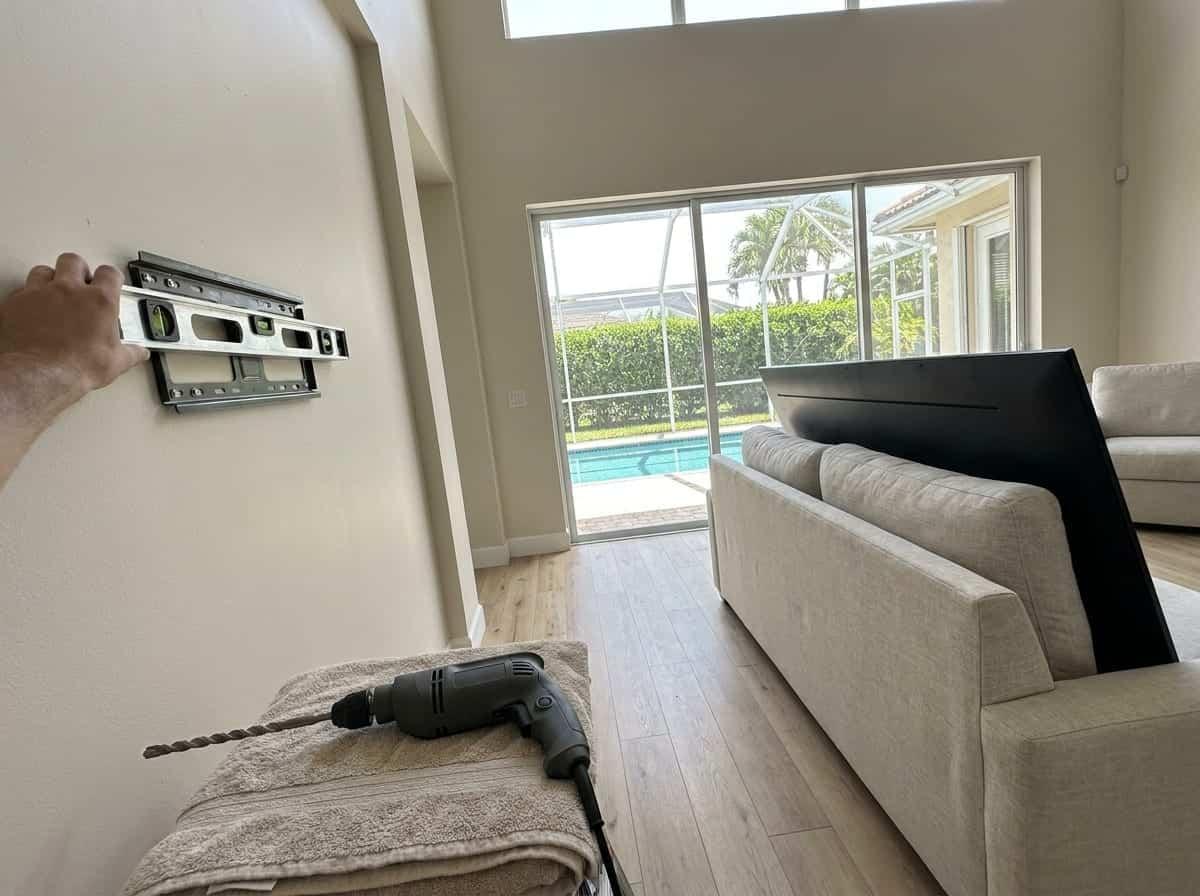
We sit where you sit. Mount height gets decided from the actual seating, not from a rule of thumb, and we check afternoon glare from the slider, which in a Florida room is the thing that makes people move a TV six months later.
We test whether the wall is CBS block, furred block with a cavity, or a framed partition. Block gets masonry anchors sized to the panel. Framing gets anchored into framing. We never hang a television on hollow wall anchors.
Panel up and levelled, cables run in raceway that can be painted to match, devices connected, every input tested with you watching. Masonry dust vacuumed, packaging taken with us, old mount holes patched if you want them gone.
Most homes and condo units in Palm Beach County are CBS, which means concrete block with a stucco face outside. Inside, that block is either furred with strips and board, leaving a shallow hollow gap, or skimmed directly. Interior partitions are typically light frame. All three look identical once painted, and only one of them takes a standard hollow wall anchor.
This is where self installed mounts fail. A toggle set into board that has block sitting a short distance behind it never opens properly, so it holds a light load for a while and then lets go, usually with a large panel attached. We test the wall in the exact spot before drilling, then use masonry anchors sized to the panel and the mount when the wall is block.
The most common regret is not the mount, it is the position. In this county the living room usually opens to a slider or a screened patio, and that glass throws hard, flat light across the room for most of the afternoon. A panel placed on the wall that faces it is unwatchable from two until sunset, which nobody notices during a morning installation.
So we look at where the light comes from as well as where the seating is. Sometimes the answer is a tilting mount, sometimes it is the other wall, sometimes it is a full motion arm so the panel can swing away from the glare. We would rather have that conversation before there are anchors in concrete than after.
We conceal cables in surface mounted raceway, which can be painted to match the wall and, on a block wall, is often the only sensible option anyway. What we do not do is run cable inside a wall cavity, add or relocate power, or touch anything hardwired. Those go to the licensed trades we refer out, and we say so before the job rather than partway through it.
In practice a well fitted raceway run disappears once it is painted, and it stays serviceable, which matters when you swap a device in three years. On a furred block wall it also avoids the discovery that there is no cavity to run anything through in the first place.
Drilling into block is loud and it carries through a building. Associations across the county set quiet hours, and an early morning hammer drill generates a complaint before the second hole. We schedule masonry work inside the allowed window, and we handle elevator padding, freight windows, and any certificate of insurance the building wants before the day of the visit.
Some buildings also restrict anchoring into a demising wall between units. If your chosen wall is shared, we check with management first. It is a two minute question that prevents an expensive conversation with a board later.
A lot of our mounting happens in units the owner is not living in. Seasonal owners buy a television during a summer sale and want it up before they arrive in the fall. Rental owners want panels mounted out of reach and cables invisible so nothing gets pulled loose between guests.
For rentals we favor fixed or tilting mounts over articulating arms, because arms invite handling and eventually loosen. We also set the panel high enough to be out of casual reach and secure the cable run so a guest cannot yank a device off a shelf. For seasonal owners we send photos and test every input so nothing is discovered on arrival day. We also leave the mount hardware and the manual with you, since a panel swap in three years is far easier when nobody has to guess what is behind the bracket.
Packages that usually include this work.
Two seasonal visits a year for absent owners. Open the house in October to December, close it in April or May.
Punch list work between guests: locks reset, walls touched up, blinds and furniture repaired, photo report on completion.
A standing program for associations and management firms: unit turns, punch lists, painting, and lock work on one monthly invoice.
We cover 39 cities, villages, and towns in Palm Beach County. These are the seven largest.
TV Mounting by city: West Palm BeachBoca RatonBoynton BeachDelray BeachPalm Beach GardensWellingtonJupiter
See all 39 service areasYes, and in Palm Beach County that is most walls. CBS block holds a large panel securely once masonry anchors sized to the mount are used. We test the exact spot first, because the same wall can be furred with a shallow cavity in one place and solid in another, and the anchor has to match what is really there.
Usually because a hollow wall anchor was used where there is block a short distance behind the board. The toggle never opens, so it grips lightly, holds for a while, and then releases. We identify the wall before drilling and use a masonry anchor when the wall is block, which is the whole fix.
We conceal cables in surface mounted raceway that can be painted to match the wall. We do not run cable inside a wall cavity, and on a furred block wall there is often no usable cavity anyway. A painted raceway disappears and stays serviceable when you swap a device later.
No. We do not add or relocate power and we do not touch hardwired work. That goes to the licensed trades we refer out, and we will give you that referral. We plan the mount and cable run around the power you already have, which in most rooms works fine.
It can be, and it is the most common reason people move a TV later. Living rooms here usually open onto a slider or screened patio that throws flat afternoon light across the room. We look at the light as well as the seating and may recommend a tilting or full motion mount, or a different wall, before drilling.
Usually a certificate of insurance on file, work inside quiet hours, and sometimes an elevator reservation with padding. Some buildings restrict anchoring into a demising wall shared with a neighbor. Tell us the building at the quote and we sort all of that before the visit rather than at the front desk.
Tell us what you need done and roughly where in Palm Beach County you are. Photos help. We come back with a price, not a sales visit.