HOA Violation Repaint
Repainting to cure an association paint violation, using the approved palette, with before and after photos for your board.
Clearing the green film, mildew, and salt haze that grows back every wet season.
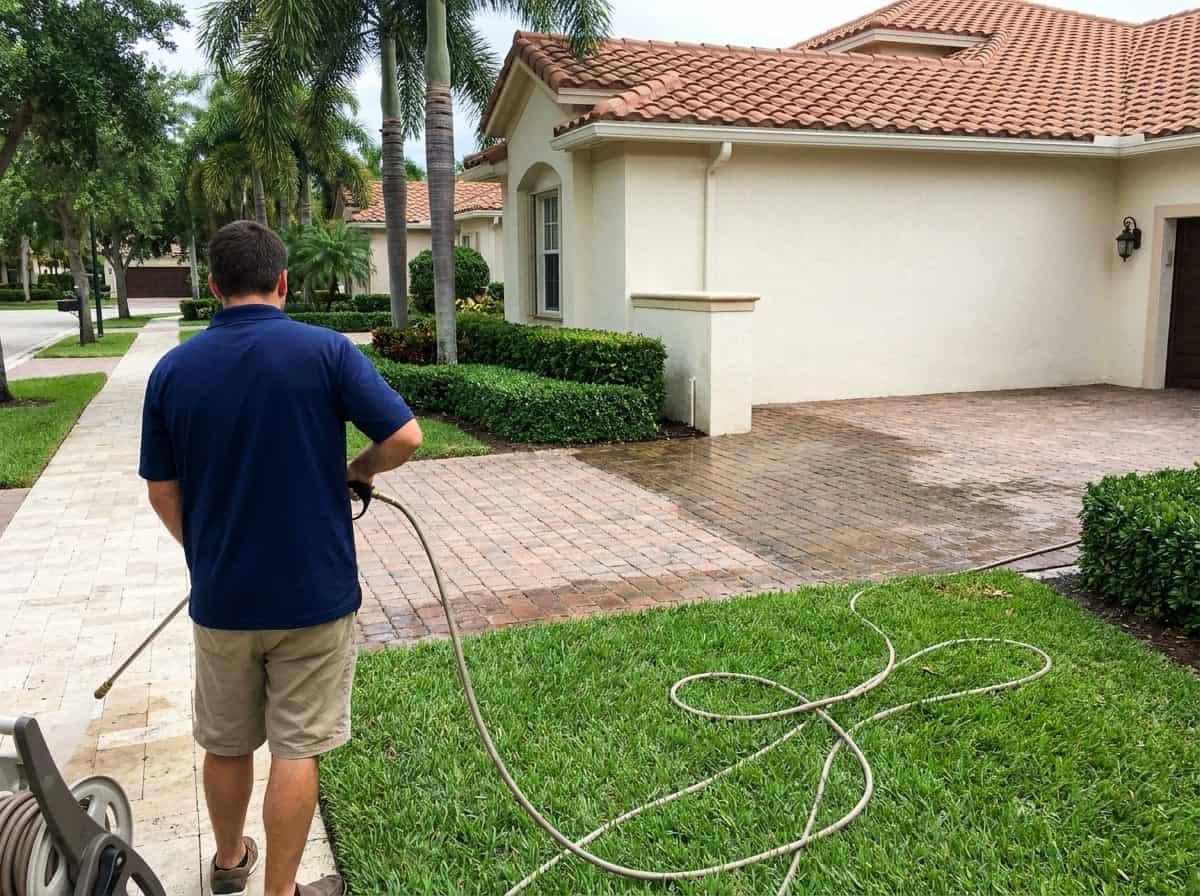
Pavers, stucco, painted trim, and screen frames each take a different pressure and a different tip. Washing everything at the highest setting is how people etch pavers and blow water behind stucco. We set the approach by surface and tell you where a treatment is needed rather than more pressure.
Plants wet down first, openings checked, and anything sensitive covered. Heavy mildew and algae get treated rather than blasted. Then we wash in a consistent pattern so the result is even, which matters most on a large driveway where streaks show from the street.
Everything rinsed down, plants rinsed again, work area cleared. We walk it with you and, if this is prep before painting, we tell you how long the surface should dry before any coating goes on it.
Palm Beach County gives mildew, algae, and lichen everything they need. Long humid months, frequent afternoon rain from June through November, warm surfaces, and shade from mature landscaping. The result is that a driveway cleaned last spring is visibly green again by the following one, and a north facing stucco wall under a tree can go from clean to spotted in a single wet season.
Near the coast there is a second layer. Salt aerosol settles on everything and leaves a haze that holds dirt to the surface. Owners often describe it as the paint looking dull rather than the wall looking dirty. Washing brings back a surprising amount of the original color, and it is the reason washing has to happen before any exterior painting.
The most common damage we get called to look at is self inflicted. Pavers etched into a striped pattern because the tip was too tight and the passes overlapped unevenly. Stucco with water driven behind it at a crack. Screen enclosure frames with the finish stripped. Painted trim with the coating peeled off in sheets.
Different surfaces take different pressure, and heavy organic growth responds to treatment, not force. Where mildew has rooted into a porous surface, more pressure just removes surface material and leaves the colony. We treat it, let it work, and then wash at a pressure the surface can survive.
A large share of this work is driven by association letters. Boards across the county cite owners for stained driveways, green walkways, mildew on entry walls, and dirty pool cage frames, and the letter usually carries a cure date. If you have one, bring it to the walkthrough, because it tells us exactly which surfaces the board is looking at and how long we have.
Washing is also the first half of a violation repaint. Where the letter cites faded or mismatched paint rather than dirt, the wall still has to be washed and dried before the coating goes on, and skipping that is why some cure repaints fail within a year. We photograph before and after so you have something to send back to your board.
Any exterior coating in this county needs a clean, rinsed, dry surface underneath it. Coating over salt film and chalk is the single most common reason a repaint fails early here. When we quote painting, washing is part of the prep, and if you already have a painter we can wash ahead of them and tell them how long to let the wall dry.
The other natural timing is spring, before storm season opens on June 1. Clearing organic growth off walkways and patio surfaces before the wet months means less regrowth over the summer, and for seasonal owners it pairs with the April or May close up visit, when a wash and a photo set leave the property looking maintained while nobody is there.
Screen enclosures are everywhere in this county and they collect a distinctive black streaking on the frames. They also need care, because too much pressure will damage the screen fabric and strip the frame finish. We wash frames at a controlled pressure and we tell you when a screen panel is already failing and washing will finish it off.
On the barrier island and in coastal communities like Highland Beach, Ocean Ridge, Juno Beach, and Palm Beach Shores, salt haze is the dominant problem rather than green growth, and the cleaning cycle is shorter. Owners there generally get more out of scheduling a rinse cycle than out of one heavy wash a year. For owners on a standing schedule, we photograph each visit so the change from one cycle to the next is visible rather than argued about.
Packages that usually include this work.
Repainting to cure an association paint violation, using the approved palette, with before and after photos for your board.
A standing program for associations and management firms: unit turns, punch lists, painting, and lock work on one monthly invoice.
Two seasonal visits a year for absent owners. Open the house in October to December, close it in April or May.
Punch list work between guests: locks reset, walls touched up, blinds and furniture repaired, photo report on completion.
We cover 39 cities, villages, and towns in Palm Beach County. These are the seven largest.
See all 39 service areasMost owners here get a year out of it, less on a shaded north facing surface under mature landscaping, where growth returns faster. Coastal properties often do better with a shorter, lighter cycle, because the problem there is salt haze holding dirt rather than heavy organic growth.
Yes, if the pressure and tip are wrong. Etched stripes on pavers and water driven behind stucco at a crack are the two things we get called to look at most often after a self install job. We set pressure by surface and treat heavy growth chemically rather than trying to remove it with force.
Yes, and bring the letter to the walkthrough. It normally lists the exact surfaces the board is looking at and a cure date, which lets us quote and schedule around it. We photograph before and after so you have something concrete to send back to your board or your manager.
Always. Coating over salt film and chalk is the most common reason an exterior repaint fails early in this county. When we paint, washing is part of the prep. If you have your own painter, we can wash ahead of them and tell them how long to let the surface dry before they start.
Yes. Screen enclosure frames pick up black streaking here and clean up well at a controlled pressure. We keep pressure off the screen fabric, and if a panel is already brittle or failing we will tell you before washing rather than putting a hole through it.
No. We do not do roof cleaning and we do not work above three stories. That is a deliberate limit. Our exterior washing covers driveways, walkways, patio surfaces, pool cages, stucco walls, doors, and soffits and fascia reachable safely from the ground.
Tell us what you need done and roughly where in Palm Beach County you are. Photos help. We come back with a price, not a sales visit.